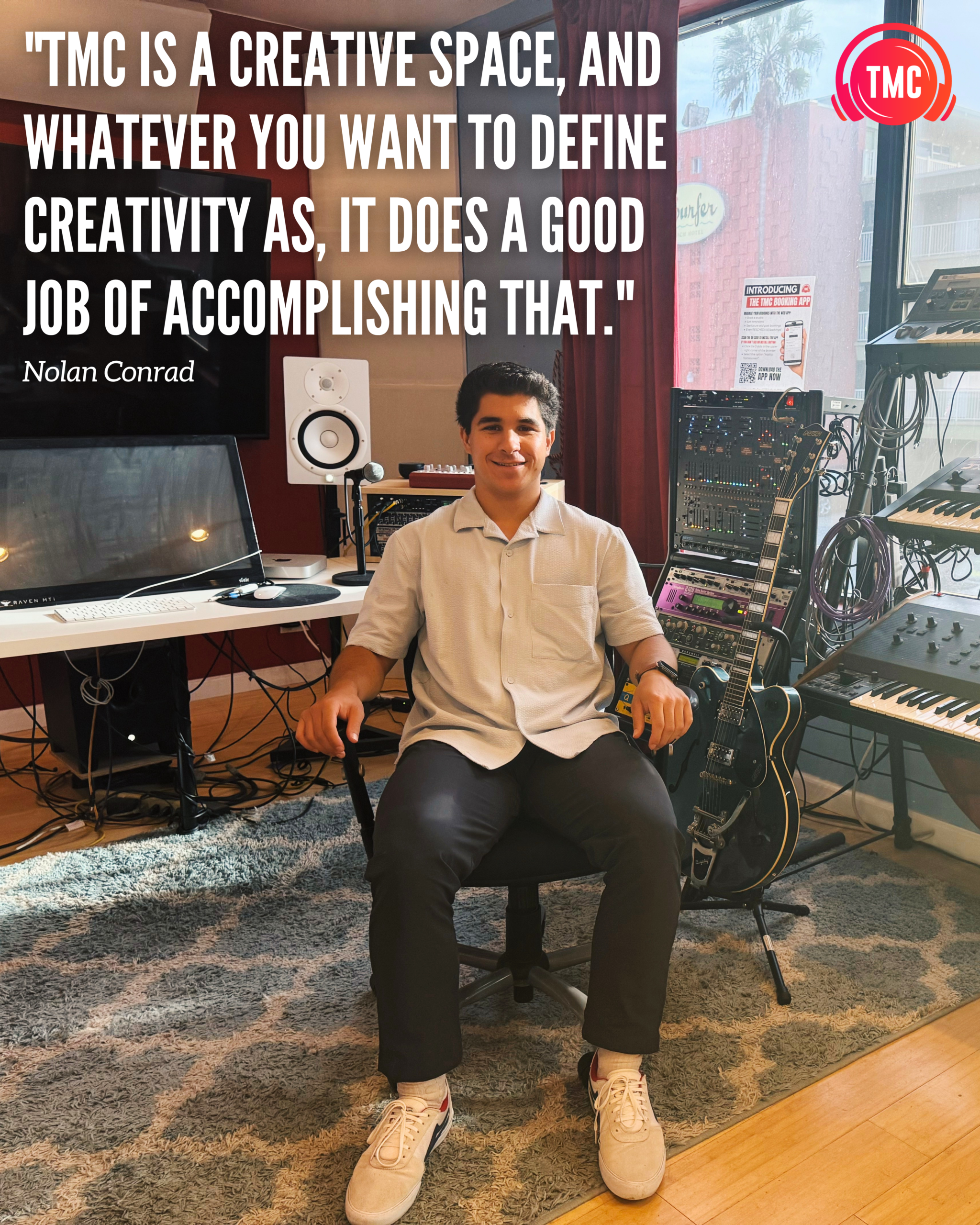
A few years ago, Nolan Conrad started coming around TMC to DJ.
After a few months, he was working at the studio, learning the ropes of audio engineering.
Nolan was an electronics student at the time, working local music gigs and with KPBS, the public media outlet on the SDSU campus. With DJing, he understood the equipment, the music, the groove, but the decks he would play at shows were way more complex than what he had at home. He needed somewhere he could practice the real thing.
When you ask him why he picked TMC over anywhere else, the answer is honest & blunt. “It was affordable and easy to book.” That, as it happens, is the whole point.
He’d never used CDJs or a full-size club mixer, so he learned it the only way he knows how to learn anything. “It’s a tactile thing. You just need to physically do it for a while.”
The more time he spent there, the more the audio engineering side started pulling at him, and eventually he asked TMC’s manager whether they were hiring. He was working within a few weeks.
One of the projects they put in front of him was taking over Audio Espresso, one of TMC’s signature recording series. “I learned pretty much the entire chain of the production process, from pre-filming to post-production,” he said, “and I made great connections and had a ton of fun while doing it.”
His other main project? Taking things apart and, most of the time (sometimes less of the time) figuring out how to fix them and put them back together.. So when a piece of equipment broke, we handed it to him…
At one point, he took a QSC amplifier, the kind that powers the speakers in TMC’s live room, completely apart. Over winter break, he carried the pieces to a professor’s electronics lab and worked through the data sheets, “which are like instructions for nerds,” next to an amp that belonged to a TMC colleague who has since become a close friend. “Kind of the beauty of engineering is you’re still guessing even when you get to a solution,” he said. “But we found the problems.”
That kind of hands-on access felt more impactful to Nolan than lecture halls. “All of the classes where it was a professor lecturing, I was terrible at,” he said. “The classes where I was hands-on doing something, I was great. I was outperforming other students where it was usually vice versa. And the tools were all here for me to be able to do that easily.”
Running client sessions taught him a different kind of skill, the kind you only pick up when everything is going wrong all at once. “I remember a couple times, all the rooms would be going off with problems or questions, and it would just be me,” he said. He got good at diagnosing things under pressure and at pulling technical information out of people who are new to a studio and didn’t always have the vocabulary to explain their issue.
All these skills walked right into the job he has now, working game days for Major League Soccer at Snapdragon Stadium. The video systems there run on the same Blackmagic equipment TMC uses, and he already knew how to move through a loud, high-pressure room full of people at every level of technical fluency. “Once I got there, I was at least like, oh, I’ve done this.”
Nolan’s story is yet another example of TMC’s mission in action. A sustainable music ecosystem isn’t built only on finished albums, high-performing streams, and big shows. It’s built by giving young people affordable, real access to professional equipment and a supportive space to explore their craft.
That’s the part we sometimes forget about how a music scene actually survives and thrives. “It’s a creative space,” Nolan said, “and whatever you want to define creativity as, it does a good job of accomplishing that.”
Your gift today helps people like Nolan find their footing, build their skills, and discover their direction. Will you donate now to help emerging artists discover what’s possible? Click here to donate.
Story by: Hannah Peterson